
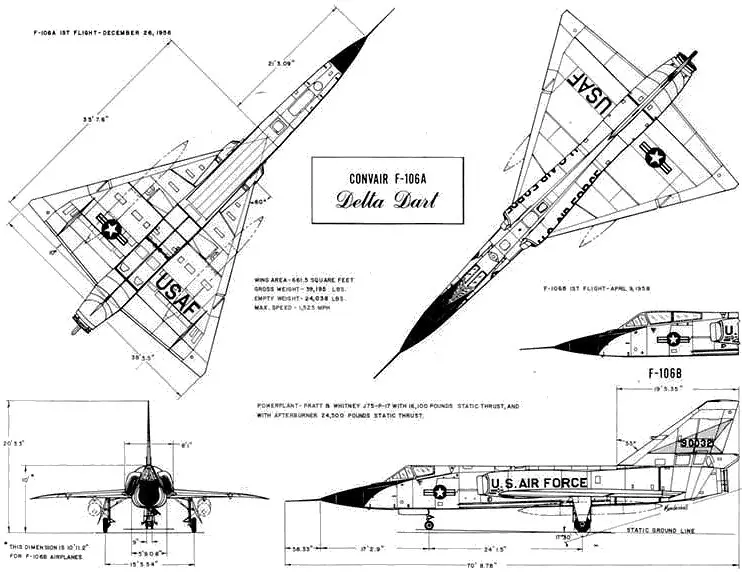
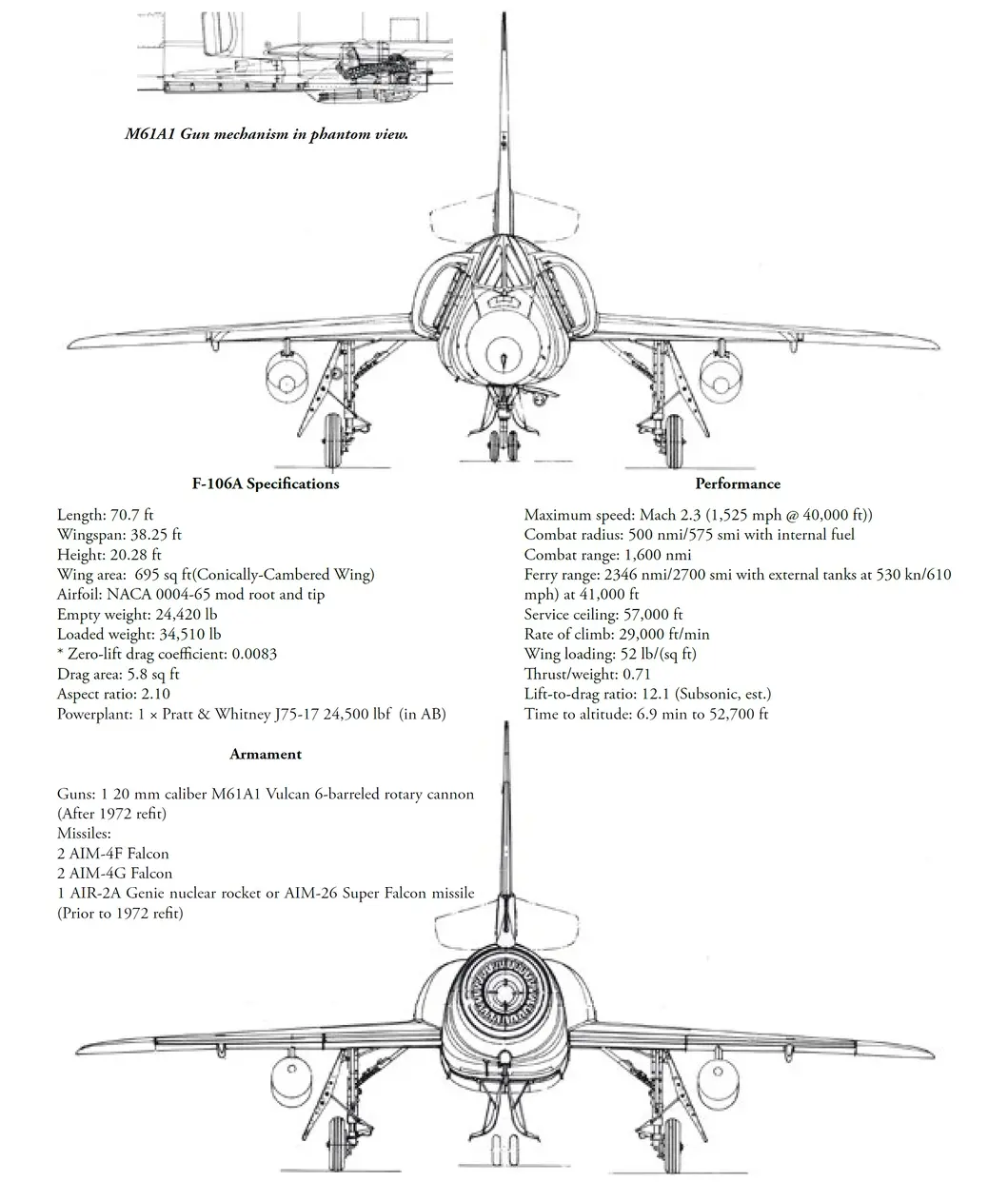
F-106A and F-106B specifications are common to both models except where noted.
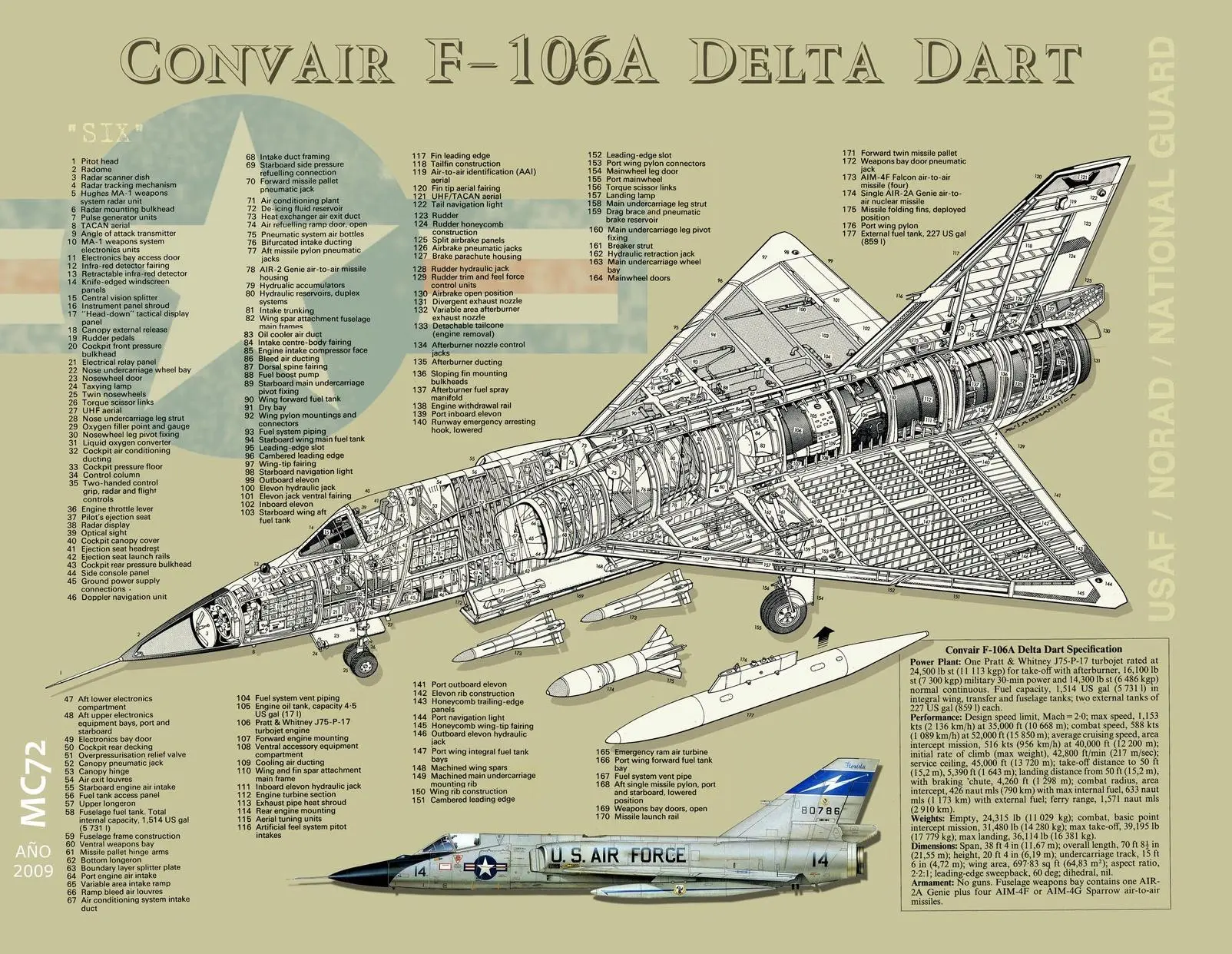
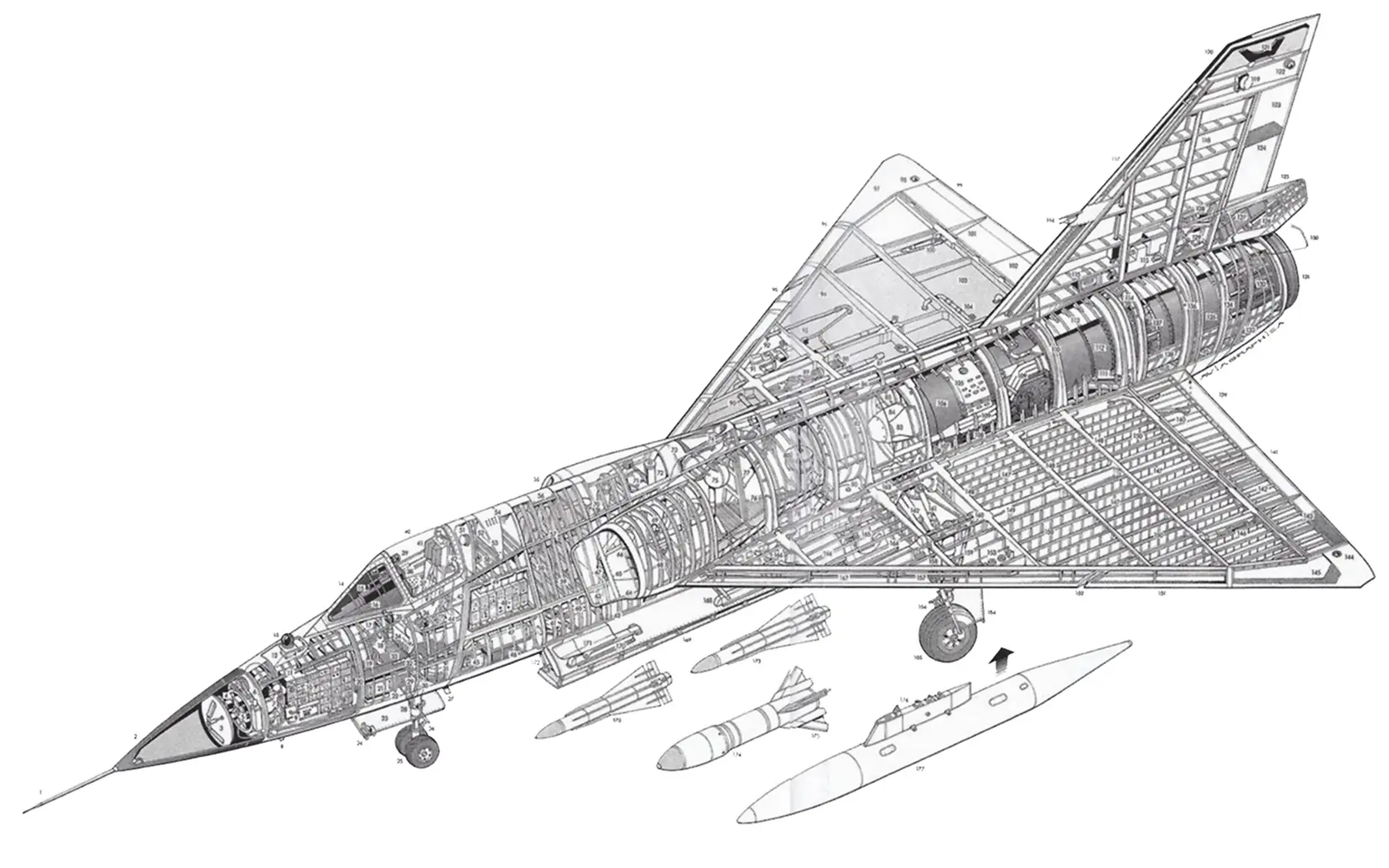
The fuselage used "area rule" principles, giving it a distinctive shape for optimized supersonic performance.
Equipped with the MA-1 Integrated Weapons Control System for automatic radar searching, tracking, and firing. Read more on our MA-1 System page.
Known as the "Ultimate Interceptor," its primary goal was to destroy incoming Soviet bombers. Read more on our History page.
The F-106 Delta Dart featured a Variable Inlet Ramp ("vari-ramp") System designed to modulate airflow to the Pratt & Whitney J75-P-17 turbojet engine, allowing for optimal performance across a wide speed range. These ramps managed the engine's intake to avoid supersonic air, which a jet engine cannot digest. The vari-ramp system was a key differentiator in performance for the "ultimate interceptor," enabling it to efficiently operate at high altitudes and speeds that surpassed the F-102 and in top-end speed, the F-4. Read more on our P&W Engine page.
There were 2 different Case Type Wingtips on the F-106: Case 14 and Case 29. The Case 14 and Case 29 wings both incorporate the strake-free wing fence - the notch in the leading edge that replaced the wing fences. The difference between Case 14 and Case 29 wings was in leading edge camber and in the wing tips where the Case 14 wings had an almost imperceptible (from a distance) upward flare at the rear of the wing tips and were end tipped slightly differently. The early 1956 models had these Case 14 wings. All subsequent aircraft had Case 29 wings where you could see the upward flare at the rear of the wing tips. These type of Case Type wingtips were not used on previous aircraft. Read more on our Design & Development page.
 Convair "Speedy Gonzales" Speed Record Certificate to Joe Rogers
 Maj Joe Rogers in cockpit of F-106A 56-0467 on 15 Dec 1959
 Convair Engineer Lloyd Miller notes during 56-0467 speed run
 Commemoration plaque mounted inside F-106A 56-0467
 Maj Rogers with F-106A 56-0467, 15 Dec 1959
 Maj Rogers with F-106A 56-0467, 15 Dec 1959
The fuselage used "area rule" principles, giving it a distinctive shape for optimized supersonic performance.
Equipped with the MA-1 Integrated Weapons Control System for automatic radar searching, tracking, and firing. Read more on our MA-1 System page.
Known as the "Ultimate Interceptor," its primary goal was to destroy incoming Soviet bombers. Read more on our History page.
The F-106 Delta Dart featured a Variable Inlet Ramp ("vari-ramp") System designed to modulate airflow to the Pratt & Whitney J75-P-17 turbojet engine, allowing for optimal performance across a wide speed range. These ramps managed the engine's intake to avoid supersonic air, which a jet engine cannot digest. The vari-ramp system was a key differentiator in performance for the "ultimate interceptor," enabling it to efficiently operate at high altitudes and speeds that surpassed the F-102 and in top-end speed, the F-4. Read more on our P&W Engine page.
There were 2 different Case Type Wingtips on the F-106: Case 14 and Case 29. The Case 14 and Case 29 wings both incorporate the strake-free wing fence - the notch in the leading edge that replaced the wing fences. The difference between Case 14 and Case 29 wings was in leading edge camber and in the wing tips where the Case 14 wings had an almost imperceptible (from a distance) upward flare at the rear of the wing tips and were end tipped slightly differently. The early 1956 models had these Case 14 wings. All subsequent aircraft had Case 29 wings where you could see the upward flare at the rear of the wing tips. These type of Case Type wingtips were not used on previous aircraft. Read more on our Design & Development page.