456 FIS Icon

456th F.I.S. Community

'Luther' Defenders of SAC

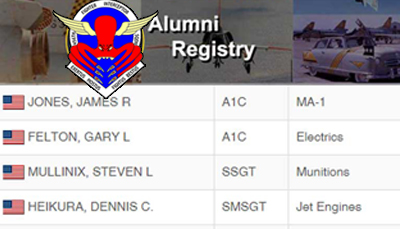
456th Alumni Database

456th Alumni

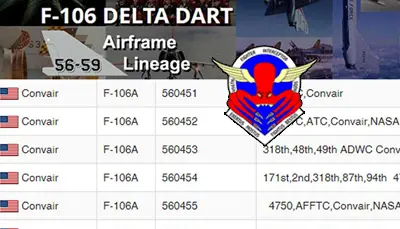
456th F-106 Aircraft Lineage

456 F-106 Aircraft

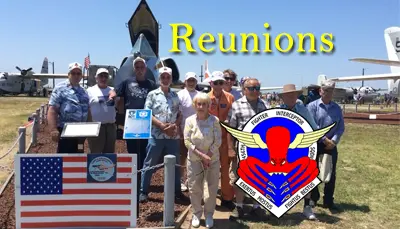
456th and F-106 Reunions

Reunions

456th Photo Gallery

456th Photo Gallery

Castle Air Museum (CAM)


Luther is Home

F-106 Delta Dart Comes Home to Castle

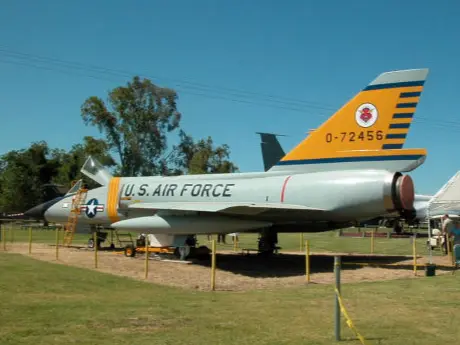
On Display Painted as 57-2456 in 1967 version markings of the 456th Fighter Interceptor Squadron Commander's plane, F-106A 58-0973 was acquired from AMARC and trucked to the Castle Air Museum (CAM) in Nov 2002.  ... Read More

Castle Air Museum456 FISLocated in Atwater, the heart of California’s San Joaquin Valley, is the largest aviation museum between Southern CA and Washington State with over 70 restored vintage military aircraft on static exhibit!  https://www.castleairmuseum.org/

456th Luther 58-0793 On Display

The Brotherhood

"I now know why men who have been to war yearn to reunite. Not to tell stories or look at old pictures. Not to laugh or weep. Comrades gather because they long to be with the men who once acted at their best; men who suffered and sacrificed, who suffered and stripped of their humanity. I did not pick these men. They were delivered by fate and the military. But I know them in a way I know no other men. I have never given anyone such trust. They were willing to guard something more precious than my life. They would have carried my reputation, the memory of me. It was part of the bargain we all made, the reason we were so willing to die for one another. As long as I have memory, I will think of them all, every day. I am sure that when I leave this world, my last thought will be of my family and my comrades. Such good men." -- Author unknown
High Flight

by John Gillespie Magee, Jr

Oh! I have slipped the surly bonds of Earth
And danced the skies on laughter-silvered wings;
Sunward I've climbed, and joined the tumbling mirth
Of sun-split clouds, — and done a hundred things
You have not dreamed of — wheeled and soared and swung
High in the sunlit silence. Hov'ring there,
I've chased the shouting wind along, and flung
My eager craft through footless halls of air. . . .

Up, up the long, delirious burning blue
I've topped the wind-swept heights with easy grace
Where never lark, or ever eagle flew —
And, while with silent, lifting mind I've trod
The high un-trespassed sanctity of space,
Put out my hand, and touched the face of God.

— John Gillespie Magee, Jr

High Flight by John Gillespie Magee, Jr

President Ronald Reagan addressed NASA employees following the tragic loss of the Challenger 7 crew STS-51L on January 28, 1986, used this poem in a well-remembered line: "We shall never forget them nor the last time we saw them, as they prepared for their mission and waved good-bye and slipped the surly bonds of Earth to touch the face of God." - President Ronald Reagan

About High Flight
During the desperate days of the Battle of Britain, hundreds of Americans crossed the border into Canada to enlist with the Royal Canadian Air Force. Knowingly breaking the law, but with the tacit approval of the then still officially neutral United States Government, they volunteered to fight the Nazis.

John Gillespie Magee, Jr., was one such American. Born in Shanghai, China, in 1922 to an English mother and a Scotch-Irish-American father, Magee was 18 years old when he entered flight training. Within the year, he was sent to England and posted to the newly formed No 412 Fighter Squadron, RCAF, which was activated at Digby, England, on 30 June 1941. He was qualified on and flew the Supermarine Spitfire.

Flying fighter sweeps over France and air defense over England against the German Luftwaffe, he rose to the rank of Pilot Officer.

On 3 September 1941, Magee flew a high altitude (30,000 feet) test flight in a newer model of the Spitfire V. As he orbited and climbed upward, he was struck with the inspiration of a poem -- "To touch the face of God."

Once back on the ground, he wrote a letter to his parents. In it he commented, "I am enclosing a verse I wrote the other day. It started at 30,000 feet, and was finished soon after I landed." On the back of the letter, he jotted down his poem, 'High Flight'.

Just three months later, on 11 December 1941 (and only three days after the US entered the war), Pilot Officer John Gillespie Magee, Jr., was killed. The Spitfire V he was flying, VZ-H, collided with an Oxford Trainer from Cranwell Airfield flown by one Ernest Aubrey. The mid-air happened over the village of Roxholm which lies between RAF Cranwell and RAF Digby, in the county of Lincolnshire at about 400 feet AGL at 11:30. John was descending in the clouds. At the enquiry a farmer testified that he saw the Spitfire pilot struggle to push back the canopy. The pilot, he said, finally stood up to jump from the plane. John, however, was too close to the ground for his parachute to open. He died instantly. He was 19 years old.

Part of the official letter to his parents read, "Your son's funeral took place at Scopwick Cemetery, near Digby Aerodrome, at 2:30 P.M. on Saturday, 13th December, 1941, the service being conducted by Flight Lieutenant S. K. Belton, the Canadian padre of this Station. He was accorded full Service Honors, the coffin being carried by pilots of his own Squadron."

John's parents were living in Washington D.C. at the time, and the sonnet was seen by Archibald MacLeish, who was Librarian of Congress. He included it in an exhibition of poems called 'Faith and Freedom' in February 1942. And after that it was widely copied and distributed. These copies vary widely in punctuation, layout, and capitalization, as I found out from readers! The original is in the Manuscript Division of the Library of Congress, and I think I've transcribed it correctly. Note that most printed versions use "... even eagle" but the original seems to be "... ever eagle," with similar penmanship to the preceding "never."

High flight was shown over pictures of mountains and American flags and fighter aircraft as a station closing video on US television stations.